Pro-Data Blog
What is an SLA and what are the benefits of this agreement?
June 2, 2022
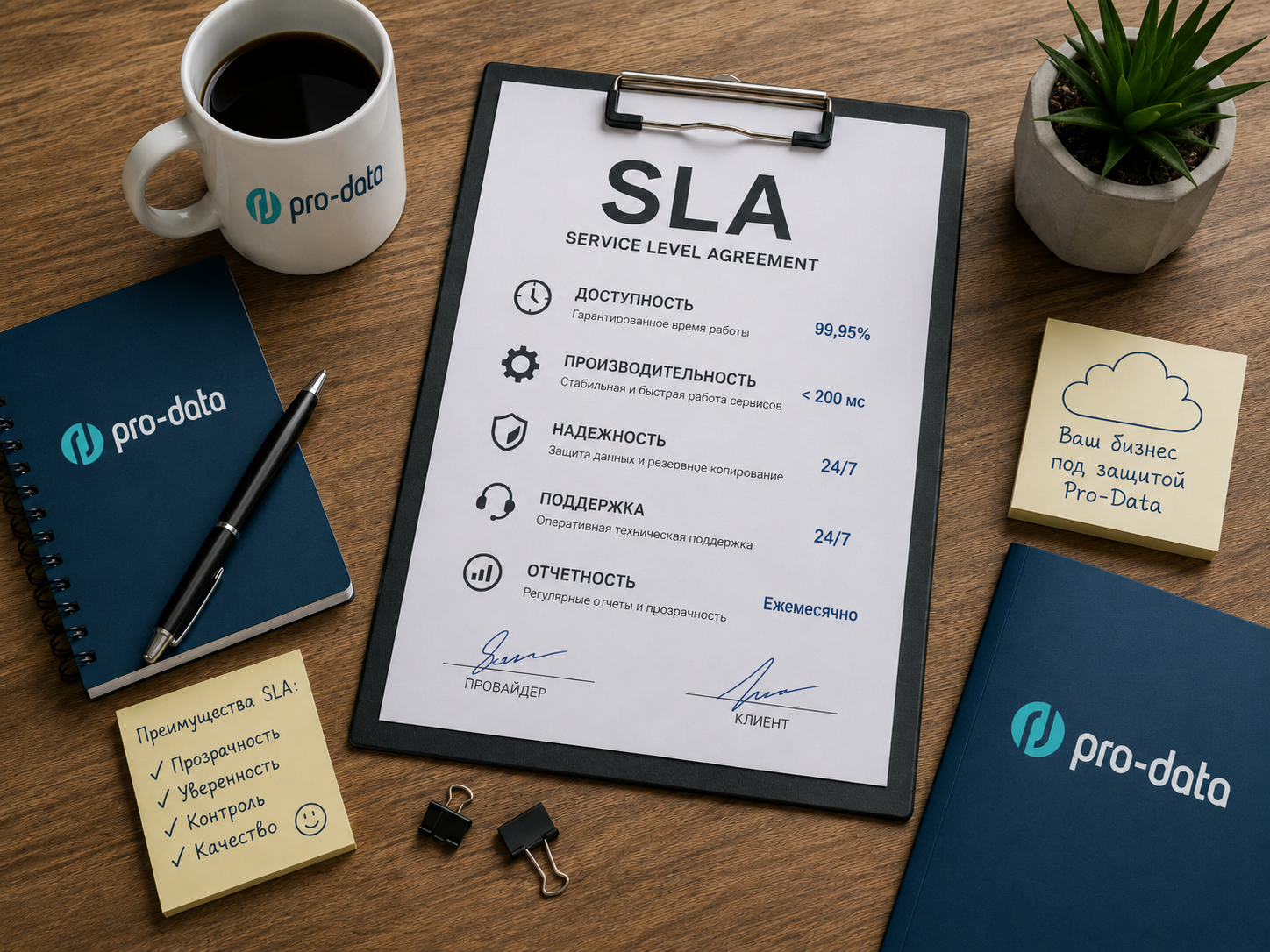



Many companies encounter the term Service Level Agreement (SLA) when ordering services from a cloud provider. An SLA is an agreement between a cloud service provider and a customer, defining the service level requirements that must be met to support the customer's business processes. It is an important tool that allows both parties to clearly define the terms and expectations regarding the quality level of the services provided. An SLA is an integral part of any cloud service contract. This agreement differs from a standard contract by providing a very detailed description of server availability. It specifies the time during which services must be available, as well as the measures that will be taken to restore service in case of unavailability. The provider's response time to various incidents is also explicitly stipulated.

The main goal of a cloud provider's SLA is to define the quality parameters of the services to be provided to the client. Each point must be clearly formulated and describe a specific type of service, as well as its established quality level.
The use of SLAs in cloud services offers several advantages. First and foremost, it allows customers to clearly define the expected level of service and data protection. It also helps cloud service providers enable their clients to clearly understand the level of service they are prepared to offer. Furthermore, an SLA helps customers minimize risks and improve the quality of their business processes. Customers can compare SLAs from different cloud service providers and choose the one best suited to their needs. Additionally, an SLA can help customers receive compensation in case of non-compliance with the contract terms.
An SLA can also help reduce IT infrastructure costs. Customers do not need to invest in additional resources to ensure a high level of data availability and protection, as the cloud service provider will handle this.
It is important to note that a cloud provider's SLA should be flexible and adapted to the client's needs. Every business has its own characteristics and requirements, so the SLA must take into account the client's specific needs.
Drafting an SLA is a responsible and labor-intensive process. The document must contain all necessary conditions that will be valid for both parties.
Responsibilities of the parties.
– The responsibilities of both the service-consuming party and the service-providing party are described in detail.
- Transparency. The agreement should not contain unclear, ambiguous, or vague wording. Terms understandable to both the customer and the provider must be used.
– Expectation management. The client should have no questions regarding what services they will receive and how they will be provided. There should also be no questions regarding project implementation timelines.
According to the current SLA, Pro-Data ensures the uninterrupted operation of its equipment used in providing services, with the exception of scheduled maintenance, work caused by equipment and software failures, and in cases where full use of its own resources is impossible due to accidents and/or force majeure.
Pro-Data guarantees 99.9% availability of dedicated computing resources for the reporting period, as per the User Agreement (SLA). In case of a breach of the aforementioned service level, the subscriber will be compensated with a percentage of the cost of the reporting period's dedicated computing resource rental at the time of the breach.
The response time (for questions and requests) in the @PRO_DATA_Support_Bot technical support bot is up to 10 minutes during normal operating hours. Technical support is available 24/7, without weekends or breaks. Request processing time can be up to 24 hours. If a request's resolution falls outside the technical support department's competence, it is forwarded to the appropriate department. Learn more
Overall, an SLA is a very important tool for both cloud service customers and providers. It helps both parties clearly define the terms and expectations regarding the quality level of the services provided. This allows customers to minimize risks and improve the quality of their business processes, while enabling providers to define what they can offer their clients and what services they can deliver.
Learn more about us or order a server for testing!